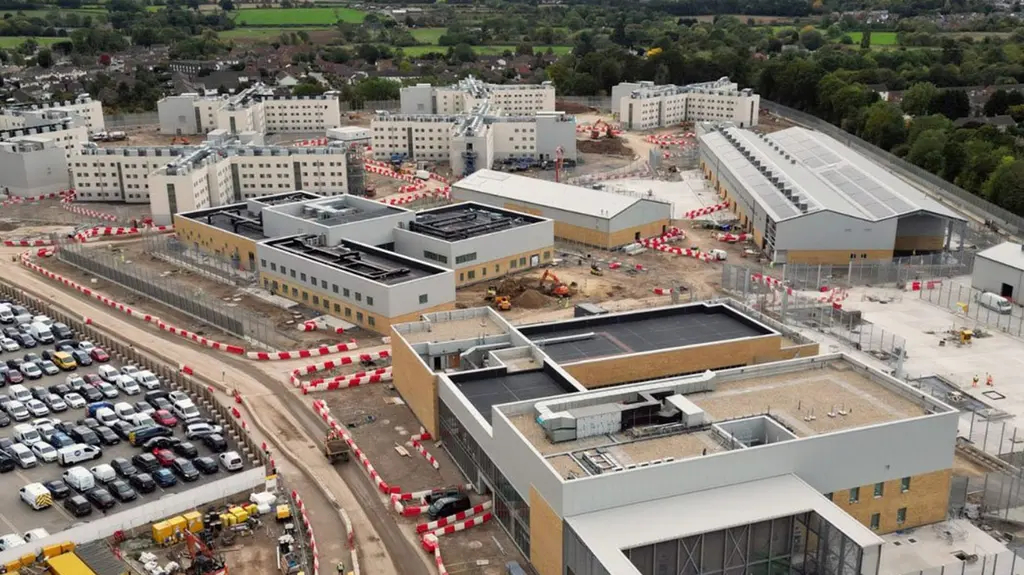
RAF Lossiemouth Training Facility
Careys undertook the role of specialist subcontractor to deliver a wideranging package of works at RAF Lossiemouth airbase in Moray, Scotland.
Client
Royal Air Force
Location
Moray, Scotland
Principal Contractor
Robertson Construction

The 98 week project commenced in June 2018 with the station continuing to operate as an operational Quick Reaction Alert station responsible for protecting UK airspace for the duration of the delivery. A phased delivery solution was implemented to meet the demands of the programme including timescales and coordination within an operational RAF base. This approach ensured that the correct resources and equipment were available for the duration of the project. This new facility incorporates a large new hanger (15m high, 120m long and 100m wide), which houses a tactical operations centre, squadron accommodation, workshops and offices, training simulators and space for three aircraft – as well as a new airfield taxi / tow way, apron and washbay area.
Careys scope included the provision of:
- Substructure building works, such as reinforced concrete (RC) pile cap and ground beam foundations, approximately 9,000m2 of ground bearing RC slab and associated service and lift pits
- Superstructure building works, comprising 150m of reinforced concrete walls, 17m of high RC service core, numerous RC columns, suspended RC slabs and 20,000m2 of upper composite floor slabs
- Site wide infrastructure, including trenching for all main services, external bases for transformers, generators and tanks and all site-wide power and communications ducting
- Access roads and a car park to service the new facility, which entails the use of 5,000m2 of external reinforced concrete (RC) service yard and 27,000m2 of external pavement quality (PQ) concrete, plus an additional 9,000m2 of PQ concrete within the hanger structure
- All external infrastructure, including airfield ground lighting ducting and pits and around 5.3km of below ground drainage networks, with attenuation tanks, separator and interceptor tanks, a foul water treatment system and a pumping station.
Key Challenges
Since this project occurred on a live Ministry of Defence site, we carefully planned our works and devised our programme to ensure that there would be no disruption to the ongoing operations of the airbase. We have been working in high security defence, aviation and nuclear environments for over three decades. We are familiar with existing best practice as well as the constant evolution of anti-terror technology and protocols.
We have several security measures in place to ensure compliance with delivering projects in highly regulated environments.
In the pre-construction phase, we appointed a Security Pass Manager who was responsible for obtaining security clearance for each worker. Checks included a full Disclosure Scotland check by Careys prior to initiating the formal security check process covering the Baseline Personnel Security Clearance BPSS and 4C’s clearance. Foreign workers who had not lived in the UK for 5 years had criminal checks in their country of origin before their formal UK security checks. The high security restrictions require all activities onsite are carefully planned and programmed by our specialist teams.
Properties in the surrounding area provide office, residential and retail space for the Defence Infrastructure Organisation. This area was consistently busy with shoppers and tourists, requiring our teams to undertake comprehensive noise and vibration monitoring to ensure that the impact and disruption to the local area was minimised to safe and appropriate levels.
Key Successes
To meet the highly regulated quality requirements, we implemented a detailed project management structure assigning key responsibilities for project delivery. Careys executed a robust site training programme which was led by experienced airfield professionals and involved upskilling the management team through specification reviews and workshops. We held mandatory training sessions with every site team member, from management to operational level. The training programme was supported by comprehensive Inspection and Testing Plans and Safe Systems of Work which detailed how we approach the works, what hold points were required, what testing was undertaken and when. We conducted reviews of the design information and participated in the optimisation of the design which improved efficiency as well as the quality outcome.
All PQ concrete was specified in accordance with Specification 033 – Pavement Quality Concrete for Airfields – Defence Infrastructure Organisation, Ministry of Defence. We worked closely with our concrete supplier and a consulting structural engineer to ensure durability; exposure classifications and strength requirements were met in addition to ensuring the best consistency for ease of pouring. By working collaboratively, we tailored the concrete mixes to the engineer’s requirements, through the use of differing cement blends, admixtures, and aggregate sizes and adapted our work inspection sheets to reflect the characteristics of the material.
“The quality, execution and finish of the concrete are considered to be excellent, with a small number of snagging issues to be resolved. There are no specific qualifications for PQC operatives compared with other external paving operations, it just the specification for airfields has more onerous requirements that a skilled concrete operative should be able to understand. On this project the competency of the site operatives and the supervision shall be commended for working in accordance with the practicalities of the DIO Specification document.”
Related projects
See more of our work like this
Related projects
See more of our work like this
Related projects